Hyderabad
Ground Floor, 11/A, Karunasri Apartment, Sanjeev Reddy Nagar X Road, Vengal Rao Nagar, Hyderabad 500038
Free pickup anywhere within 40 km: Hyderabad, Secunderabad and Cyberabad.
Address, map and hours




Send homemade food, pickles, medicines, clothes, and urgent documents from Hyderabad to Tanzania via DHL, FedEx, UPS, and direct economy lines. We weigh your parcel at your doorstep, pack it in 3-layer safety boxes, and handle all customs paperwork.
From ₹490/kg on 21kg+ · free doorstep pickup & 3-layer packing · DHL, FedEx, UPS & more
 SLP Express
GST & packing included
Book from either branch: same prices, same 3-layer packing, same carriers. Open all 7 days, 9 AM to 8 PM.
Ground Floor, 11/A, Karunasri Apartment, Sanjeev Reddy Nagar X Road, Vengal Rao Nagar, Hyderabad 500038
Free pickup anywhere within 40 km: Hyderabad, Secunderabad and Cyberabad.
Address, map and hours6-10-37, near Subbayya hotel, beside HP Gas Agency, Rama Rao Peta, Kakinada, Andhra Pradesh 533004
Free pickup anywhere within 40 km: Kakinada, Samalkot, Pithapuram, Peddapuram, Yanam and around.
Kakinada branch pageSLP Express has worked from Hyderabad since 2008, independently of any single carrier. For Tanzania that means DHL Express, FedEx, UPS Express and Economy compared on your weight, with Economy (Duty paid by receiver) for parcels that can wait. Weighing, measuring and photographs all take place at your side, and the SLP mark goes on before the box leaves your home. After pickup, the Hyderabad team you spoke to answers you on WhatsApp.

Send us your list on WhatsApp, with a guess at the weight and the Hyderabad area we should come to. We check the items against what the Tanzania Revenue Authority (TRA) and agencies such as TMDA and TPHPA publish, then reply with a price. After the full address arrives, we agree a time to collect. Nothing to print, nowhere to queue.
At your home the box is weighed with you watching and built up in three layers. Plain words and real values go into our invoice and customs declaration, because TRA's system rejects declarations that are incomplete or poorly described. The carrier's tracking number follows when active, and so do our WhatsApp updates at each stage.
Personal parcels reach Tanzania well when every item is named plainly with its true value. Medicines need a TMDA permit and plant products a TPHPA permit, so share your complete list before pickup and we check it.
These cannot travel to Tanzania with us, under East African customs law or our own rules:
Rates effective 9 Nov 2026 · INR · all-inclusive, GST included
Swipe sideways to compare Economy, FedEx, UPS and DHL →
| Weight | Economy | FedEx | UPS Express | DHL |
|---|---|---|---|---|
| 500 g | ₹2,200LowestDuty paid by receiver · 8-12 working days | ₹4,3003-5 working days | ₹3,9003-6 working days | ₹6,3002-3 working days |
| 1 kg | ₹2,400LowestDuty paid by receiver · 8-12 working days | ₹4,5003-5 working days | ₹4,2003-6 working days | ₹7,5002-3 working days |
| 2 kg | ₹2,800LowestDuty paid by receiver · 8-12 working days | ₹5,4003-5 working days | ₹5,1003-6 working days | ₹9,5002-3 working days |
| 3 kg | ₹3,100LowestDuty paid by receiver · 8-12 working days | ₹6,5003-5 working days | ₹6,4003-6 working days | ₹11,5002-3 working days |
| 4 kg | ₹3,500LowestDuty paid by receiver · 8-12 working days | ₹7,5003-5 working days | ₹8,1003-6 working days | ₹13,4002-3 working days |
| 5 kg | ₹3,900LowestDuty paid by receiver · 8-12 working days | ₹8,6003-5 working days | ₹9,7003-6 working days | ₹15,2002-3 working days |
| 6 kg | ₹3,500LowestDuty paid by receiver · 8-12 working days | ₹13,9003-5 working days | ₹11,4003-6 working days | ₹16,9002-3 working days |
| 7 kg | ₹3,800LowestDuty paid by receiver · 8-12 working days | ₹15,1003-5 working days | ₹13,0003-6 working days | ₹18,5002-3 working days |
| 8 kg | ₹4,200LowestDuty paid by receiver · 8-12 working days | ₹16,3003-5 working days | ₹14,2003-6 working days | ₹20,1002-3 working days |
| 9 kg | ₹4,500LowestDuty paid by receiver · 8-12 working days | ₹17,5003-5 working days | ₹15,4003-6 working days | ₹21,8002-3 working days |
| 10 kg | ₹4,900LowestDuty paid by receiver · 8-12 working days | ₹18,7003-5 working days | ₹16,6003-6 working days | ₹23,4002-3 working days |
| 11 kg+ | ₹490/kgLowestDuty paid by receiver · 8-12 working days | ₹1,820/kg3-5 working days | ₹1,650/kg3-6 working days | ₹2,250/kg2-3 working days |
| 21 kg+ | ₹490/kgLowestDuty paid by receiver · 8-12 working days | ₹1,580/kg3-5 working days | ₹1,550/kg3-6 working days | ₹1,840/kg2-3 working days |
Discounts, duty paid or duty extra? Confirm with our team before you book. Check all available services here →
Tanzania courier charges (full table) → Open price calculator →
A summary of what TRA and the other authorities of Tanzania publish about parcels sent from India, as read on 7 October 2026. It is general information, not legal advice, and rules change: before you rely on a figure, open the source link under it.
Customs for goods sent from India to Mainland Tanzania is run by the Tanzania Revenue Authority (TRA) under the East African Community Customs Management Act (EACCMA) and its 2010 regulations, using its electronic system TANCIS. Ordinary imports are cleared by a licensed clearing and forwarding agent, but parcels have their own rules: customs may accept the postal form or a registered courier's own declaration instead of a full entry, a registered courier can be licensed as a customs agent, and the post office produces postal articles to customs. TRA's pre-arrival declaration facility does not cover goods imported by post parcel or courier. Other bodies set rules for particular goods: the Tanzania Medicines and Medical Devices Authority (TMDA) for medicines, the Tanzania Plant Health and Pesticides Authority (TPHPA) for plants, seeds and plant products, the Tanzania Bureau of Standards (TBS) for product-quality checks, and customs, the Bank of Tanzania and the Financial Intelligence Unit for cash declarations. This file covers Mainland Tanzania; Zanzibar has its own VAT rate and was not researched.
Source: Tanzania Revenue Authority: import procedures (TANCIS, import documents, rejection of incomplete declarations); Tanzania Revenue Authority: pre-arrival declaration (not used for post parcel and courier imports) (read 7 October 2026)
Since 26 September 2025 the EACCMA, as amended in 2025, says that where the customs value of imported goods is USD 50 or less no import duty is collected (the older rule only waived duty amounts of USD 1.5 or less). A small gift or parcel whose goods are worth USD 50 or less therefore pays no import duty. The customs value is the price paid or payable for the goods; in the 2019 text of the valuation rules freight is not added for goods imported by air, but insurance and handling charges are. This is an import-duty rule only: the texts read show no VAT relief for low-value parcels (the VAT Act's list of exempt imports covers baggage and personal effects that are duty-exempt under the Act, a gift to the State and other special cases). A separate rule lets customs accept a courier's own declaration instead of a full customs entry, but only for packages that are not over 70 kg and USD 1,000 each; larger packages need the normal entry. TRA's July 2025 tax summary predates the USD 50 rule, and the texts do not say whether it is applied per item, per parcel or per customs document.
Source: East African Community Customs Management (Amendment) Act, 2025 (assent 30 Nov 2024, in force 26 Sep 2025), as published by TRA; East African Community Customs Management Act, 2004, Revised Edition 2019 (as published by TRA): Second, Fourth and Fifth Schedules (read 7 October 2026)
Import duty is charged on the customs value of the goods at the rates of the East African Community Common External Tariff, which depend on what the goods are: 0 percent for raw materials, pharmaceuticals and capital goods, 10 percent for semi-finished goods, 25 percent for finished consumer goods, 35 percent for fully finished goods and special-tax items, and more for some sensitive goods (TRA's July 2025 summary gives salt at 50 percent and mineral water at 60 percent and keeps worn clothing at 35 percent). On top come VAT at 18 percent on imported taxable goods in Mainland Tanzania (15 percent in Zanzibar), a customs processing fee (0.6 percent of the FOB value in TRA's July 2025 summary), and a railway development levy of 2 percent of the customs value (TRA's July 2025 figure). Some goods also carry excise (used electrical appliances including mobile phones 25 percent, used tableware 20 percent, imported furniture 25 percent). VAT on imports falls due on the day the goods enter Mainland Tanzania. Duty on a postal parcel is collected by the post office and paid over to customs; a registered courier presents the goods to a customs officer for examination and assessment of duty. If the addressee does not claim a postal article, or refuses to pay the duty, it goes to the customs warehouse.
Source: Tanzania Revenue Authority: Taxes and Duties at a Glance 2025 (certified July 2025); East African Community Customs Management Regulations, 2010 (as published by TRA): Parts VIII and IX on post and registered couriers (read 7 October 2026)
For a parcel sent by post, the sender's customs declaration must accompany the parcel (or be securely attached to one of them if the goods are in several parcels) and must give an accurate description of the quantity or weight, the country of origin and the value of the contents; if the goods are commercial, an invoice or statement with full particulars goes inside the parcel and is marked on the outside. The same applies to courier articles, where the courier presents the goods to customs. TRA's import procedure lists the usual import documents (final invoice, packing list, a transport document such as the airway bill, any import permits from TMDA, TBS or TASAC, exemption papers, and the cross-border currency declaration) and says TANCIS automatically rejects declarations that are incomplete or insufficiently described. For goods that TBS regulates under its pre-shipment verification programme a certificate of conformity is needed before shipment unless an exemption applies: personal goods (application letter plus residence, work or student permit, passport or baggage declaration) or a consignment valued below USD 5,000 (application letter plus TRA proof of the invoice value); exempted goods still get a destination inspection. Plants and plant products sent by post or courier must be labelled in English or Kiswahili with their contents and have the required documents attached to the outside of the package, and an inspector may open the package.
Source: East African Community Customs Management Regulations, 2010 (as published by TRA): Parts VIII and IX on post and registered couriers; Tanzania Revenue Authority: import procedures (TANCIS, import documents, rejection of incomplete declarations) (read 7 October 2026)
Prohibited imports under the EACCMA (Second Schedule, Part A) and Tanzanian law include: false money and counterfeit currency; pornographic and obscene material in any medium; matches made with white phosphorus; articles made without authority with a partner state's coat of arms; harmful distilled drinks such as absinthe (with an exception for some anise liqueurs); narcotic drugs under international control; hazardous wastes; soaps and cosmetics containing mercury; listed agricultural and industrial chemicals (for example DDT, aldrin and parathion); counterfeit goods of all kinds; and plastic articles thinner than 30 microns for conveying or packing goods. A postal or courier article that holds prohibited goods, or whose contents do not match its entry or invoice, is treated as goods imported contrary to the Act and can be detained.
Source: East African Community Customs Management Act, 2004, Revised Edition 2019 (as published by TRA): Second, Fourth and Fifth Schedules; East African Community Customs Management Regulations, 2010 (as published by TRA): Parts VIII and IX on post and registered couriers (read 7 October 2026)
Restricted imports need a permit or special approval. The EACCMA (Second Schedule, Part B) lists: any goods whose import is regulated by another law; postal franking machines; traps that can kill or capture game; unwrought precious metals and precious stones; arms and ammunition and their parts, telescope sights for arms and collectors' arms; detonators, percussion caps and flares; armoured fighting vehicles; bows, arrows and fencing foils (the list also names 'toys' under tariff chapter 95 without saying which); ivory, rhinoceros horn, hippopotamus teeth, tortoise shell, coral, natural sponges and articles of bone, horn or shell; spent nuclear fuel; ozone-depleting substances; genetically modified products; non-indigenous fish species or eggs; endangered species and their products under CITES; second-hand tyres; psychotropic drugs under international control; and historical artefacts. TRA's summary says live animals, plants, firearms, ammunition and ivory need a permit from the relevant authority. Medicines need a TMDA permit, plants and plant products need a TPHPA import permit and phytosanitary certificate (see “Plants, seeds and animal products”), and goods that TBS regulates need a certificate of conformity or an exemption (see “Papers and ID the recipient needs”).
Source: East African Community Customs Management Act, 2004, Revised Edition 2019 (as published by TRA): Second, Fourth and Fifth Schedules; Tanzania Revenue Authority: Taxes and Duties at a Glance 2025 (certified July 2025) (read 7 October 2026)
Plants and plant products: the Plant Health Act 2020 makes anyone importing plants (defined to include seeds and other living plant parts), plant products or regulated articles apply for an import permit, and says every consignment must carry the TPHPA import permit, the original phytosanitary certificate from the exporting country's authority and copies of the shipping documents. Hay, straw, rice husks, peat and chaff may not be used as packing, and wood packaging must be treated. The 2023 regulations sort imports by pest risk: low-risk items may come on general conditions (permit, certificate, free of soil, labelled, in clean new packaging), high-risk items only after a pest risk analysis, and prohibited items are seized and destroyed or returned at the importer's cost. Anything introduced by post or courier must be labelled in English or Kiswahili with its contents, have its documents attached outside the package, and may be opened by an inspector. Non-compliant consignments can be detained, treated, re-shipped or destroyed at the importer's cost. 'Plant products' include any unmanufactured material of plant origin, so raw plant foods fall under these rules. TRA says live animals and plants need a permit from the relevant authority, and the EAC list restricts CITES species, ivory and GM products. The official pages show no rule for meat, dairy, honey, fish or eggs sent to a private person.
Source: Plant Health Act, 2020 (TPHPA): sections 21 to 28 on import permits and documents; Plant Health Regulations, 2023, GN 284 (TPHPA): regulations 57, 58, 72 and 74 (read 7 October 2026)
A person entering or leaving Tanzania with currency or bearer negotiable instruments worth USD 10,000 or more (or the equivalent in shillings or another currency, at the Bank of Tanzania rate) must declare them to customs on the prescribed form. The anti-money-laundering regulations count the mailing or shipping of currency and bearer instruments as cross-border transport, and customs has a separate declaration form for currency in shipped parcels and cargo with the sender's and recipient's identity details; TRA lists the cross-border currency declaration among import documents. The penalty for not declaring is seizure of the whole undeclared amount; for smaller cases (up to USD 30,000, not linked to crime) customs may instead compound the offence at 10 percent of the undeclared amount. The Foreign Exchange Regulations 2022 repeat the USD 10,000 declaration limit for people entering or leaving. Unwrought precious metals and precious stones are restricted imports and counterfeit currency is prohibited. The official pages show no rule on jewellery.
Source: Anti-Money Laundering (Cross-Border Declaration of Currency and Bearer Negotiable Instruments) Regulations, 2016, GN 268 (Financial Intelligence…; Bank of Tanzania: Foreign Exchange Regulations, 2022, GN 294, regulation 4 (read 7 October 2026)
Dated changes: (1) the East African Community Customs Management (Amendment) Act 2025 (assent 30 November 2024, in force 26 September 2025) introduced the rule that no import duty is collected on goods of customs value USD 50 or less, and also lets the Council issue directives on duty values for used goods and accepts electronic records and forms. (2) The Finance Act 2026 (in force 1 July 2026) lists no parcel-specific change; it indexes specific excise rates each year (inflation plus 2 percent). (3) TRA's July 2025 summary of the 2025/26 budget records higher duty on salt (50 percent) and mineral water (60 percent). (4) TBS published a 2025 pre-shipment verification guideline and exemption list (March 2025 tariff lists) and a summarised procedure dated August 2026.
Source: East African Community Customs Management (Amendment) Act, 2025 (assent 30 Nov 2024, in force 26 Sep 2025), as published by TRA; The Finance Act, 2026 (in force 1 Jul 2026), as published by TRA (read 7 October 2026)
Describe every item in plain words with its real value: TRA's system rejects incomplete or poorly described declarations, and a postal or courier article whose contents do not match its entry or invoice, or that holds prohibited or regulated goods without the right conditions, is treated as goods imported contrary to the Act and can be detained. A courier must present all goods to a customs officer for examination, and an unclaimed postal parcel, or one whose duty the addressee refuses to pay, goes to the customs warehouse. For a parcel worth USD 50 or less only duty is waived; the texts read show no VAT or processing-fee relief for it. TRA's pre-arrival declaration facility is not used for post parcel and courier imports. TRA's toll-free call centre lines are 0800 750 075, 0800 780 078 and 0800 110 016, with WhatsApp 0744 233 333 and services@tra.go.tz. Mainland Tanzania and Zanzibar differ (VAT is 15 percent in Zanzibar).
Source: East African Community Customs Management Regulations, 2010 (as published by TRA): Parts VIII and IX on post and registered couriers; Tanzania Revenue Authority: import procedures (TANCIS, import documents, rejection of incomplete declarations) (read 7 October 2026)
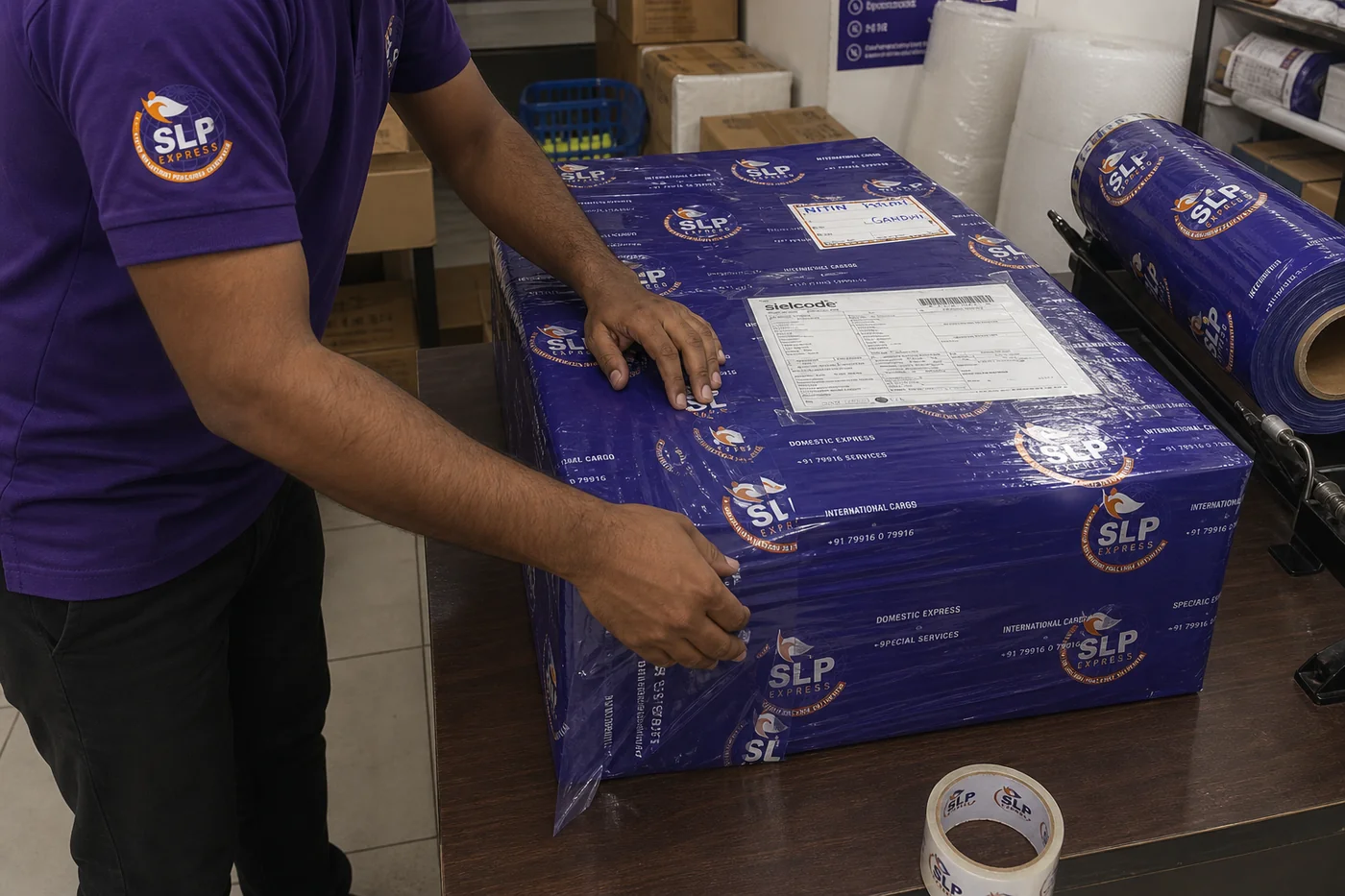
Every parcel collected in Hyderabad is weighed on a calibrated digital scale in front of you and packed at our Ground Floor, 11/A, Karunasri Apartment, Sanjeev Reddy Nagar X Road, Vengal Rao Nagar desk or your doorstep.
We bring the materials, so you only hand over what is going. Things are wrapped and sealed, cushioned on every side and boxed in an export-grade carton; the SLP seal goes on last. Breakables are padded generously, and liquids are sealed twice. Tanzania's plant-health rules forbid hay, straw or rice husks as packing, and we use none of them.
Food items and pickles are triple-pouched and vacuum-sealed; clothing and soft goods are vacuum-compressed; medicines and documents are sealed inside moisture-barrier sleeves.
Closed-cell bubble wrap and corrugated dividers isolate fragile items, spices, and textiles so oil or spice aroma never transfers inside a mixed family carton.
Heavy-duty 7-ply corrugated outer box trimmed to the exact height of your contents (L × W × H ÷ 5,000), double-taped and strapped so you never pay for empty air.

In collaboration · Abhiruchi Swagruha Foods, Hyderabad since 1992
A box of sweets from home often means more than anything else in the parcel. We work with Abhiruchi Swagruha Foods, Hyderabad sweet makers since 1992: buy at any of their Hyderabad outlets and we collect it with your pickup, pack it food-safe and send it in the same shipment to Tanzania.
Illustrations of each step, from pickup to handover.
Your first Tanzania parcel starts with a list sent on WhatsApp, along with your area. We tell you what can go, whether anything needs a TMDA or TPHPA permit, and the price. Then our team packs it at your home, as you watch, and the invoice and declaration are drawn up by us. If TRA asks something during clearance, we answer it with you.
As soon as the carrier's tracking is live, the number is yours. WhatsApp updates follow at the true milestones: picked up from you, flown from India, landed in Tanzania, released by TRA, on the delivery round, delivered.
A missed delivery in Tanzania usually ends in another attempt or a nearby hold by the carrier. We follow the tracking and message you quickly, so the parcel is collected in Tanzania and not returned to India.
Transparent rate comparison across DHL Express, FedEx, UPS Express and Economy, free doorstep pickup, and full Tanzania Revenue Authority (TRA) Customs paperwork preparation.
Share your approximate weight, item list, and the recipient's Tanzania postcode on WhatsApp (+91 99510 83676). Our Hyderabad desk compares DHL Express, FedEx, UPS Express and Economy and replies with an all-inclusive quote.
Choose a collection window that suits you (9 AM to 8 PM, all 7 days). Our executive collects from your home or office anywhere across 50+ Hyderabad and Secunderabad localities.
We weigh your items on a calibrated digital scale in front of you and check carton dimensions so you only pay for actual or trimmed chargeable weight.
Vacuum-sealing for foods, compression wrapping for garments, bubble cushioning for breakables, and a custom-trimmed 7-ply corrugated export carton.
We prepare the itemised customs declaration, English HS descriptions and sender KYC packet so your parcel clears Tanzania Revenue Authority (TRA) Customs smoothly.
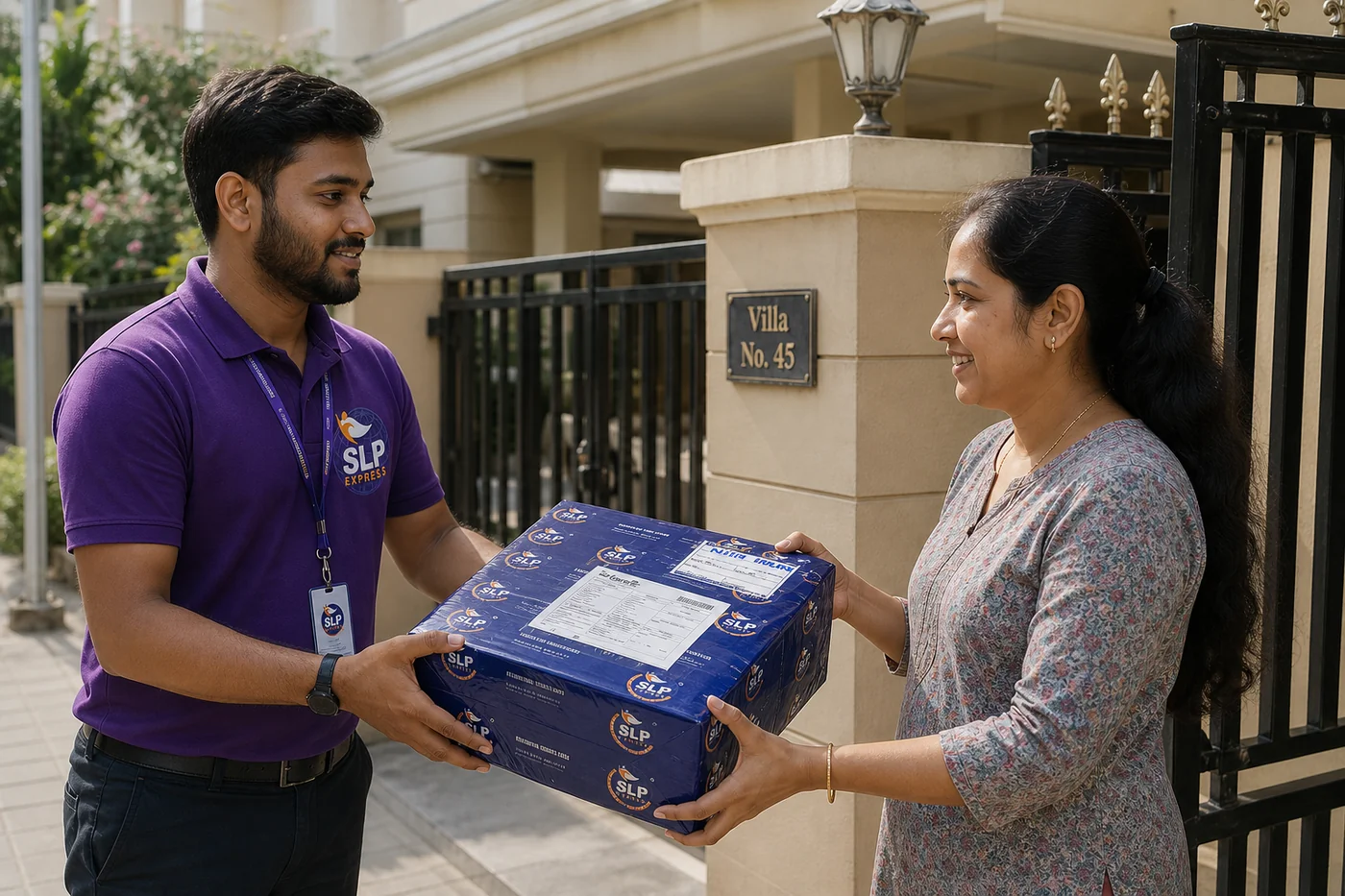
Dispatched via DHL Express, FedEx, UPS Express and Economy (DHL Express 2-3, FedEx 3-5, UPS Express 3-6 and Economy 8-12 working days). You receive the live AWB tracking number on WhatsApp from Hyderabad uplift until signed doorstep delivery in Tanzania.
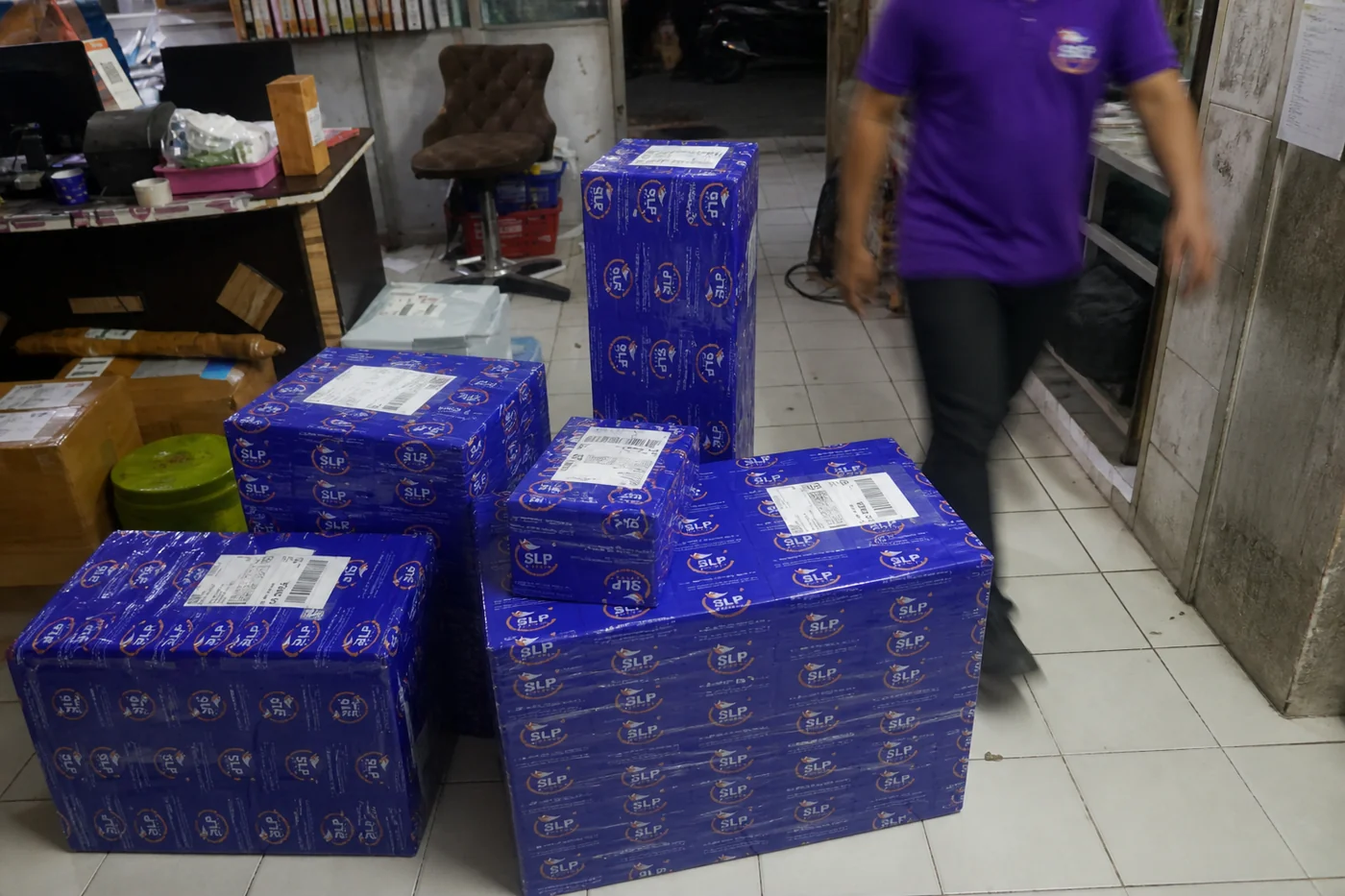
Four categories of shipments leave our Ground Floor, 11/A, Karunasri Apartment, Sanjeev Reddy Nagar X Road, Vengal Rao Nagar hub for Tanzania every week.
Homemade Andhra pickles, spice podis, dry festival sweets, silk sarees and care packages sent from parents in Hyderabad to children and grandchildren settled in Tanzania.
21+ kg excess baggage boxes containing winter jackets, pressure cookers, utensils, textbooks and personal effects shipped to university dorms and apartments across Tanzania.
Up to a 90-day personal supply of chronic-care tablets (BP, diabetes, thyroid, cardiac) shipped with doctor's prescription and pharmacy GST bills matched for Tanzania Revenue Authority (TRA) Customs review.
Sealed university transcripts, WES packets, legal POAs, and 21–500 kg commercial/IEC export consignments dispatched with full CSB-IV or CSB-V paperwork.
Keep these ready on WhatsApp — our Hyderabad desk prepares all printed airwaybills and customs invoices.
Rated 4.9/5 from 203 Google reviews. Read the reviews.
Every area of Hyderabad gets free pickup, including ones not shown below. WhatsApp your address; once a time is agreed, we can usually be there within 2 hours of confirming.
Written for this lane and for parcels from Hyderabad generally.
Customs and service guidance on this page references:
Rules change. Confirm the current position before you ship — we check it with the carrier on every booking.