



Why Packing Matters for International Courier from Hyderabad
Domestic couriers inside India sometimes forgive a loose carton. International carriers — DHL, FedEx, Aramex, and UPS — run your parcel through automated sort belts, aircraft holds, and multiple hand-offs. A box that rattles, leaks, or collapses under a stack will not survive that journey.
Good packing protects three things at once:
- Your items — ceramics, electronics, glass jars, and folded clothing all need different cushioning.
- Your customs clearance — customs officers may open a poorly sealed or suspicious parcel; honest, tidy packing speeds inspection.
- Your bill — carriers charge on chargeable weight (the higher of actual weight vs volumetric weight). An oversized empty box costs you money even if the contents are light.
When you book through our international courier services, professional packing at your door is included at no extra charge. Many families still like to understand the method so they can prepare items in advance.
Step 1: Choose the Right Outer Box
Start with a new or like-new double-wall corrugated carton. Recycled grocery boxes soften in humidity and crush in the cargo hold. For most Hyderabad-to-abroad personal parcels (2–21 kg), these sizes work well:
- Small (up to 2 kg): roughly 30 × 25 × 20 cm — documents, medicines, a few clothing layers.
- Medium (2–7 kg): roughly 40 × 30 × 30 cm — mixed gifts, podis, small electronics.
- Large (7–21 kg): roughly 50 × 40 × 40 cm — consolidated family parcels, multiple sarees, student baggage items.
The box should be slightly larger than your contents so you can add 5–8 cm of cushioning on every side. If the carton is half empty, fill void space with crumpled paper or air pillows — items must not shift when you shake the box.
Step 2: Wrap and Cushion Every Item
Think in layers: item → inner wrap → rigid shell (if needed) → carton fill → outer seal.
- Soft goods (clothes, sarees, blankets): fold flat, place in a poly bag to keep dry, no sharp corners pressing outward.
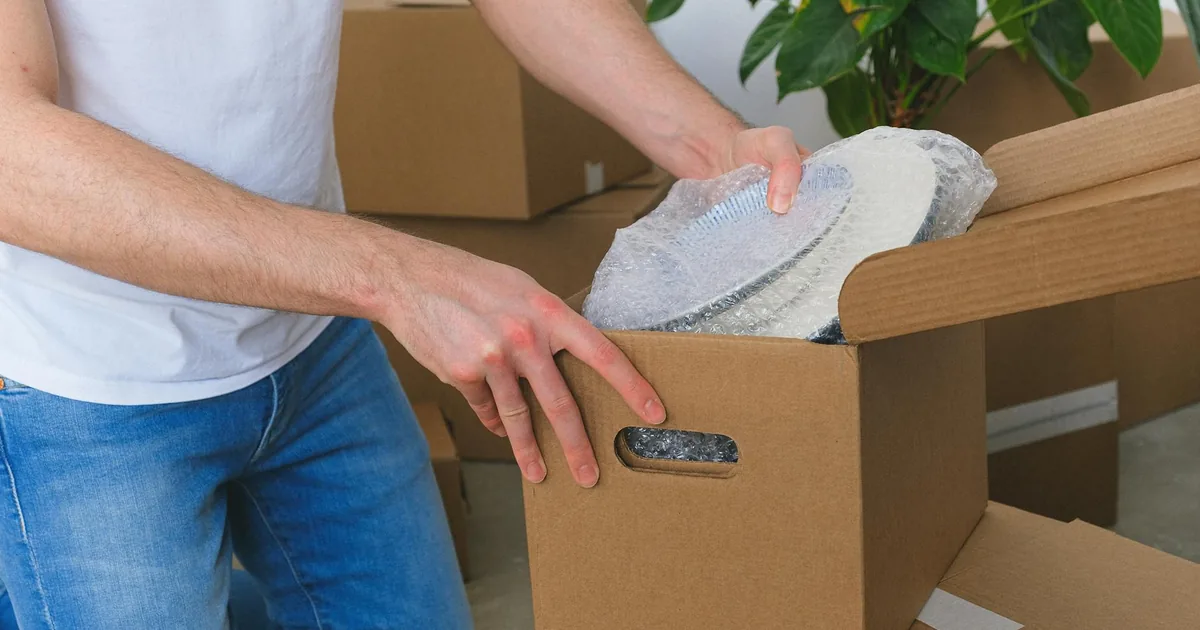
- Fragile items (crockery, idols, glass): minimum three wraps — bubble wrap, then corrugated sheet, then snug placement with no contact between pieces.
- Liquids and food (pickles, ghee, oils): primary heat-sealed food pouch, secondary zip-lock with absorbent paper, rigid plastic tiffin or container, then outer carton. Never ship open containers.
- Electronics: remove loose batteries where possible, wrap in anti-static or bubble wrap, mark “FRAGILE” on two faces of the carton.
Place the heaviest items at the bottom centre of the box and lighter items on top. Never put weight on something that can bend — a laptop under books will crack the screen in transit.
Step 3: Seal, Label, and Prepare for Pickup
Sealing is not only about tape aesthetics; it is a customs and carrier compliance step.
- Use 50 mm+ plastic packing tape on all seams — bottom H-tape pattern, top H-tape, and edge reinforcement on corners.
- Do not use string, rope, or brown paper wrapping on the outside; automated scanners and belts reject non-standard exteriors.
- Write the receiver’s full address on a label inside the box and on the outside (carrier labels will be added at pickup).
- Keep a list of contents for your own reference; our team will prepare the commercial invoice and customs declaration when we weigh the parcel.
Before the driver arrives, clear one table or floor space so we can re-weigh, add carrier labels, and apply final waterproof tape if needed. Free doorstep pickup across Hyderabad is standard on every international booking.
Volumetric Weight: How Box Size Affects Your Bill
International carriers do not bill on actual weight alone. They use chargeable weight = max(actual kg, volumetric kg). Volumetric weight is calculated from box dimensions — a large, lightly filled carton can cost as much as a smaller, denser one.
Example: a box measuring 50 × 40 × 40 cm has a volumetric factor that often pushes chargeable weight above 13 kg even if clothes inside weigh only 6 kg. That is why we trim void space and choose the smallest safe carton.
Use our dimensional weight calculator before you pack if you want to compare box sizes, then confirm final pricing on our live pricing tool. Rates update monthly; pickup and packing remain free.
Fragile, Food, and Electronics: Category-Specific Tips
Fragile gifts and pooja items: double-box method — inner small carton for each fragile piece, outer carton with 8 cm padding. Mark FRAGILE on four sides. We see excellent results to the USA, UK, and Gulf when dividers separate multiple brass lamps or ceramic sets.
Homemade food and pickles: Hyderabad families often send avakaya, gongura, podis, and sweets abroad. Pouch-first packing beats glass jars for weight and leak risk. Every food parcel needs an honest ingredient description for customs — we prepare that paperwork at pickup.
Medicines and documents: keep original blister packs and prescription copies together in a sealed inner bag; certificates go in a rigid document folder with cardboard stiffener so they do not crease.
Student baggage: mix of clothes, books, and gadgets — pack books flat at the base, cushion laptops in the centre, and avoid mixing food with textiles (odour transfer and customs questions).
What SLP Express Does at Your Doorstep
When you book via WhatsApp or through our services page, our packer arrives with cartons, bubble wrap, pouches, and tape. The standard workflow:
- Inspect what you want to send and advise on prohibited or restricted items for your destination country.
- Re-pack into carrier-suitable cartons if your home packing needs reinforcement.
- Weigh on calibrated scales in front of you and explain actual vs volumetric chargeable weight.
- Generate the air waybill, attach carrier labels, and shares live tracking after carrier activation.
You pay only the confirmed courier charge — no surprise packing fee, no counter visit. That is why most repeat customers from Madhapur, Kukatpally, and LB Nagar let us handle the final seal even when they pre-sort items at home.
Common Packing Mistakes to Avoid
- Over-sized box with empty space — inflates volumetric weight; fill voids or downsize the carton.
- Single-layer bubble wrap on glass — insufficient for international belts; use double wrap plus dividers.
- Mixing undeclared items — hidden batteries, cash, or extra food pouches cause customs holds and carrier penalties.
- Weak tape on the base seam — bottom burst is the most common mechanical failure we see on self-packed parcels.
- Shipping prohibited items — aerosols, flammables, perishable meat, and certain seeds are restricted; ask us before you pack.
Getting packing right once saves reshipment cost, family disappointment, and days lost at foreign customs. For a live quote on your destination and weight band, open the pricing calculator or message us with photos of your items — we respond with a confirmed rate and pickup slot, usually within minutes during business hours.